Hong Kong Foodie Tour Review: Is It Worth Booking?


Disclosure: This article contains affiliate links. See the Disclosure Policy.
On my most recent trip to Hong Kong, I booked and paid for a Hong Kong Foodie tasting tour myself: no sponsorship, no freebies. I really loved it and I will definitely book another one of their tours on my next trip.
I did the Sham Shui Po tour (one of my favourite areas in Hong Kong that has an authentic local vibe). The tour was well organised, genuinely fun, and not only did I get to try lots of different foods, I learnt a ton about Hong Kong food culture, too (yes, even though I lived here and return all the time).

Hong Kong Foodie Tour (Sham Shui Po)
⭐ Best for authentic local food experiences
⭐ Licensed English-speaking guide
⭐ Great for first-time visitors
⭐ Includes multiple tastings over 3 hours
If you’re visiting Hong Kong for the first time, especially if you feel intimidated by local restaurants or unsure what to order, I genuinely think this tour is worth doing early in your trip. That’s because it demystifies a lot about Hong Kong food and how things work here. You’ll get more out of the rest of your time as a result.
The Hong Kong Foodie tour is also very easy to fit into a day of sightseeing. The 9am start time is unusual for a food tour (I find most start later in the day), but it works. You’re not waiting around all day, and you can get on with other things afterwards.
The guide was licensed (which not all are in Hong Kong), reliable, and well organised. She turned up exactly as planned — which isn’t always guaranteed here.
Why I Chose The Hong Kong Foodie Sham Shui Po Tour

Even though I know Hong Kong food really well from living here and returning often, I still had gaps.
There were foods I’ve never tried (milk tea & cheung fun), places I’d never quite felt confident walking into, and things I’d walked past for years without really understanding. Cha chaan tengs, for example — I knew what they were, but I’d never properly gone in and ordered, mainly because of the language barrier.
So I decided to go on a food tour for my most recent visit back.
📌If you’re trying to figure out what foods are actually worth trying in Hong Kong, I also have a guide to the best traditional Hong Kong foods to eat.
Before I booked, I spent quite a bit of time comparing food tour options on Viator.
I was looking for a few specific things:
- a licensed guide
- guaranteed departure (I didn’t want it cancelled if I was the only person)
- a good mix of food samples
- a walking tour that helped me understand Hong Kong beyond just the food
I narrowed it down between two: The Hong Kong Foodie Sham Shui Po tour, and the Kowloon Michelin-Rated Street Food and Culture Tour.
In the end, I chose the Hong Kong Foodie Sham Shui Po tour to do on this trip, and I would save the Kowloon Michelin-Rated Street Food and Culture Tour to do the next time I am in Hong Kong.
The main reason I chose it is because I really love Sham Shui Po, which is the neighbourhood the Hong Kong Foodie tour focuses on. It’s one of the poorer areas of Hong Kong, but also one of the most vibrant — full of local markets, wet markets, and everyday food.
The Kowloon Michelin-Rated Street Food and Culture Tour, on the other hand, takes you through Mong Kok and Yau Ma Tei — areas I’m already very familiar with.

The Hong Kong Foodie tour also ticked a lot of boxes for me. The cost was similar to other Hong Kong food tours, and the company had been around for a long time.
It was founded by a local Hong Kong woman, Cecilia. Cecilia, who happened to be my guide the day I was doing the tour, has worked abroad and speaks fluent English so everything was easy to understand.

The meeting point was inside the MTR station, with clear instructions. As it turned out, I was the only person on the tour that day. Cecilia was easy to spot with her name badge, and we got started straight away.
We started at 9am, which is quite early for a food tour. I wasn’t sure about that at first — I thought things might not be open or it might feel a bit flat. But it was actually perfect.
The neighbourhood was already buzzing, bakeries were in full swing, and it felt completely local and not staged for tourists.
👉 If you want to experience a more authentic side of Hong Kong food culture, check prices and availability for the Sham Shui Po tour here.
😋 Why I personally recommend the Hong Kong Foodie Tour (Sham Shui Po):
- helped me feel more confident eating in Hong Kong afterward
- authentic non-touristy neighborhood
- excellent cultural explanations
- easy for first-time visitors
What I Actually Did On The Hong Kong Foodie Tour

This is a walk, eat & talk tour, where we visited different places, ate (generous portions by the way), talked about the food, its cultural significance, and the establishments themselves, and then moved on to the next stop.
On this tour, we visited:
- small family-run restaurants
- bakeries
- street-facing food spots
- local shops (traditional dried food shops and a culinary implements shop where they make their own knives)
It’s not just about eating — it’s also:
- a walking tour
- an introduction to how Hong Kong food culture actually works
👉 If you want more than just a standard food tour, you can check the latest Hong Kong Foodie tour availability here.
I arrived at 9am and finished around 12.15ish pm, so the tour is about three hours. The route is an easy flat walk with toilet breaks if you need them.
The Food I Tried on the Hong Kong Foodie Tour

The first stop was a cha chaan teng (Hong Kong diner). I’ve walked past these places my whole life and never gone in one. The menus are often in Chinese, the combinations can look quite strange (macaroni with ham, for example), and I’ve never quite had the confidence to go in and just order.

So having it explained properly — what it is, why it exists, how it reflects Hong Kong’s take on Western food — made a big difference. It was really good to finally go in and understand what it’s about.
😍 This was honestly one of the moments that made the tour feel worth it to me — you can check availability here.
We had:
- a huge pineapple bun — much bigger than I’d ever seen before, but light, fresh, and really good
- traditional Hong Kong milk tea — not a fan.
When I first moved to Hong Kong as a little girl, we had to use evaporated milk with our cereal because fresh dairy in Hong Kong wasn’t really a thing back then. I hated it with a vengence (I was a kiwi lass used to farm fresh milk!) I’ve never gotten over it, so the milk tea wasn’t for me, but it was still good to finally try it properly.
We also watched the tea being made — strained multiple times through what looks like pantyhose (it isn’t, but that’s what it looks like).
From there, we moved through a series of very local places.

We ate:
- rice noodle rolls (cheung fun) in a small, very local restaurant — something I’d never tried before because they always looked a bit bland, but with the sauces and sesame they were actually really good
- a tofu dessert
- dumplings, where we could see two women making them fresh in large volumes
- noodles made using bamboo, which was a really interesting process to see
We also stopped at a local bakery, where Cecilia explained local delicacies like mooncakes (very dense, often with bean paste, and surprisingly expensive).

These weren’t curated, tourist-friendly places. These were places locals go and uniquely Hong Kong, and that’s exactly what I wanted.
👉 Check availability for the Sham Shui Po tour if you want a more local food experience in Hong Kong.
What I Loved about this Food Tour
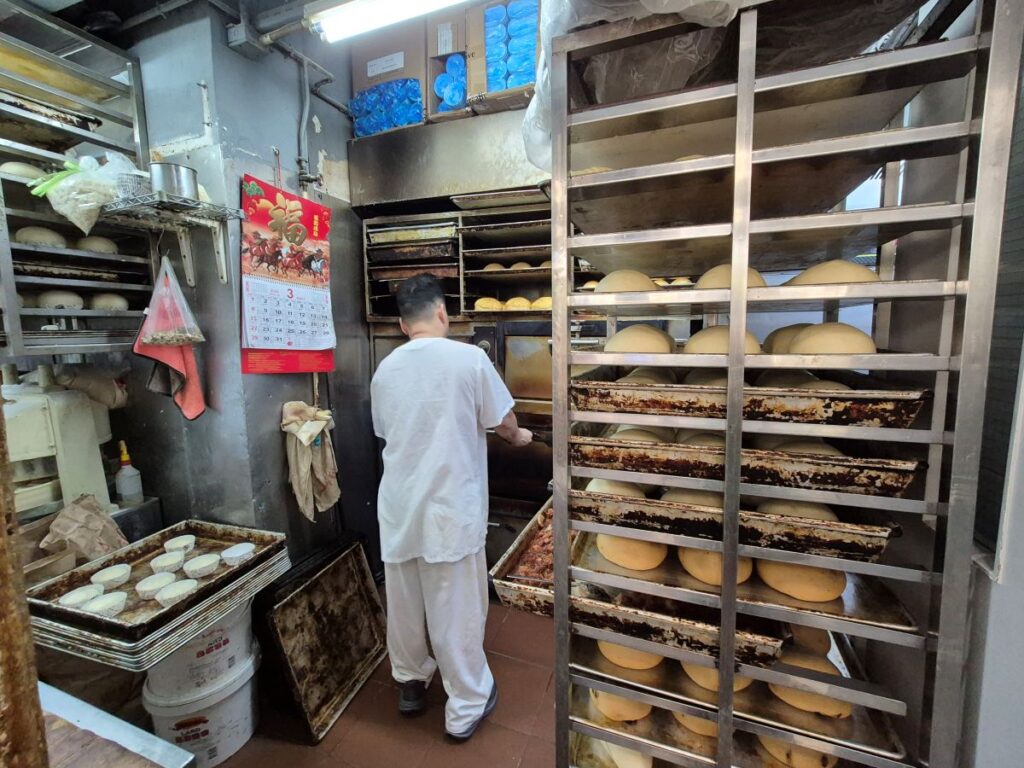
I really liked finally getting inside places I’ve walked past for years but never gone into.
That was probably the biggest value for me — not that you can’t go into them yourself, but knowing what you’re looking at and what to order. Having a guided tour gives you a cultural bridge — you come away with:
- knowing what to order
- understanding what you’re eating
- feeling comfortable walking in
The Cha Chaan Teng experience was worth it alone. I’ve walked past them for years without going in.
Having someone explain:
- what these diners are
- why they matter culturally
- how locals actually order
completely changed the experience for me.
This ended up being one of the most valuable parts of the tour because afterwards I felt much more confident about eating in the local places I’ve shied away from.
👉 If you’re nervous about ordering food in Hong Kong, I genuinely think this tour is worth doing early in your trip.
I also loved being in Sham Shui Po with someone who clearly knew the area. You could see the relationships — shop owners recognising her, conversations happening naturally — and that adds a layer you don’t get on your own.

And I learned more than I expected about how these places actually run — often as multi-generational family businesses — and how it’s actually becoming harder to keep them going because younger generations don’t necessarily want to take over
And Sham Shui Po itself — I’ve always liked it, but this gave me a different perspective on it. The friendliness of the neighbourhood really stood out as well.
What I didn’t love

Not every food we tried was to my taste. The milk tea, for example.
And some of the foods aren’t things I’d normally choose. But that’s kind of the point of doing a tour like this. And I’m glad I tried everything.
Even if you’re not an adventurous eater, the guide does a great job explaining everything along the way.
Is the Hong Kong Foodie Tour Worth the Price?

This isn’t a cheap activity. In fact, it will probably be one of the more expensive activities you’ll do while you’re in Hong Kong. But just remember that 85% of what you’ll do in Hong Kong is either free or very low cost.
If you’re still trying to decide whether food tours are actually worth as part of your Hong Kong trip, I’ve written a full breakdown on that too.
Hong Kong food tours are definitely more expensive than food tours in places like Thailand or Vietnam.
But after comparing multiple tours myself, it was in line with the other Hong Kong food tour options.
👉 Compare current pricing for the Hong Kong Foodie tour here.
What made this one worth it for me was:
- the licensed guide
- guaranteed departure (even if I was the only person — which I was)
- genuinely local neighborhood
- cultural explanations
- food variety
- small-group feel
I also left extremely full.
More importantly, even after spending most of my life living in and visiting Hong Kong, I still came away with a much deeper understanding of the city’s food culture — and discovered places and foods I probably would never have tried on my own.
You’re paying for the food, but also for the structure, the knowledge, and the confidence to walk into these places afterwards.
Practical Info (What to Know Before You Book)

- Start time: 9am (earlier than most, but it works)
- Meeting point: Inside the MTR — very easy, clear instructions
- Group size: I ended up being the only person
- Walking: Easy, but you are on your feet the whole time
The guide was organised, easy to find, and clearly knew both the food and the area well.
Final Verdict: Would I Recommend the Hong Kong Foodie Tour?

Yes — especially for first-time visitors to Hong Kong.
Even as someone who used to live in Hong Kong, I still learned a huge amount from this tour.
It helped me:
- understand local food culture better
- feel more confident ordering food
- discover places I would’ve ignored on my own
- experience a less touristy side of Hong Kong
If you’re trying to decide whether the Hong Kong Foodie Tour is worth booking, I genuinely think it is.
I’d especially recommend doing it early in your trip because it makes the rest of your Hong Kong food experiences much less intimidating afterward.
It also gives you an easy introduction to one of the things that makes Hong Kong worth visiting in the first place: its incredible food culture.
Ready to Book the Hong Kong Foodie Tour?
👉 Check latest prices and availability for the Sham Shui Po tour here.
Other Hong Kong Foodie Tours To Consider

If you’re undecided about Sham Shui Po, Hong Kong Foodie Tours also runs tours in Central and around the Temple Street Night Market.
Central Food Tour
If you’re staying on Hong Kong Island or are short on time, the Central tour is probably the most convenient option. It focuses more on classic Hong Kong foods in a much more central tourist-friendly area.
✨Check Central Tour Availability
Temple Street Night Market Tour
If you specifically want a night market experience, this is probably the better choice. The tour helps you navigate the Temple Street food stalls and choose what’s actually worth trying, before ending with a sit-down meal.
