What to Eat in Hong Kong: A First-Timer’s Guide


Disclosure: This article contains affiliate links. See the Disclosure Policy.
Hong Kong is one of the best food cities in the world, but if it’s your first time here, it’s not always obvious what to eat.
My advice is to keep it simple. Start with a handful of classic dishes: dim sum, roast meats (like char siu or roast goose), a pineapple bun, and an egg tart. Add a quick cha chaan teng meal and a couple of street snacks like curry fish balls, and you’ll get a real feel for Hong Kong’s food straight away.
😋Considering a food tour? I recommend Hong Kong Foodie Tour (Sham Shui Po) for a first visit. I did this recently at my own cost. It was a really good mix of Hong Kong’s must-try foods without trying to cram too much in.
Trust me when I tell you that food and eating out is going to be one of the best (and most memorable) parts of your Hong Kong trip.
I don’t say that lightly. I’ve been eating my way around Hong Kong for over forty-five years — first growing up here in the 1980s, back when Sunday yum cha meant noisy family tables, rolling dim sum carts, and arguing with my siblings over the last dumpling.
I still visit Hong Kong regularly, and the foods I’ve just mentioned are the ones I always come back to.
Below I share more about my favourite must try Hong Kong eats, along with the different types of places you’ll come across — from cha chaan teng cafés and dim sum restaurants to bakeries, street food spots, and more.
What to Eat in Hong Kong (Quick List for First-Timers)
If you only try a handful of things on your first trip, make it these:
Roast Goose

Deeply savoury, glossy-skinned, slightly smoky. The skin should be crisp, the meat juicy, and the flavour rich without being greasy. Order it with rice and greens and you’ve got a very typical Hong Kong meal.
Char Siu (BBQ Pork)
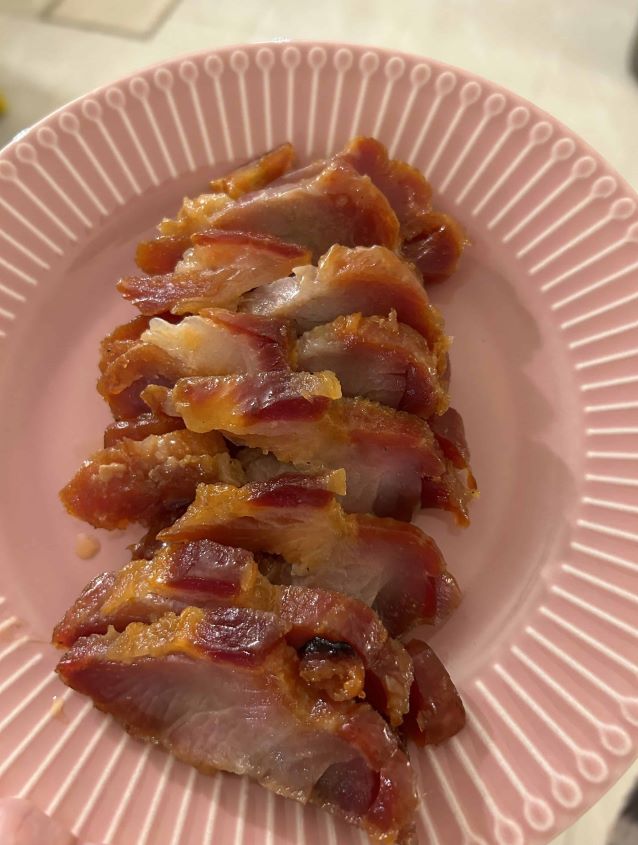
This is BBQ pork belly with crisp crackling on top and tender meat underneath. Locals queue for good versions. If you hear loud chopping behind a glass case, you’re in the right place. I get mine in the local Hong Kong grocery store, Wellcome Shop.
Siu Mai

Open-topped pork dumplings, usually with a little orange roe on top. You’ll see them in dim sum restaurants and sometimes as street snacks on sticks. These are my new favourite.
Curry Fish Balls

A childhood staple for a lot of us who grew up here. Bouncy fish balls simmered in a mild curry sauce, usually served on a skewer. They’re not fancy. They’re nostalgic, slightly spicy, and very Hong Kong.
Pineapple Bun (Bo Lo Bao)

No pineapple involved. It’s named after the crackly, sugary top that looks like the fruit. Best eaten warm, sometimes with a thick slab of butter melting inside. Buy one from a neighbourhood bakery and eat it as you walk.
Egg Tart

You’ll usually see two styles:
- The classic Hong Kong version with smooth pale custard
- The Portuguese-style with a caramelised top
Try both. Eat them warm if you can.
✅FYI: You don’t need to worry about food safety. Hong Kong is very well regulated, and in all my years of eating here, I’ve never been sick.
Dim Sum (Yum Cha)

Even if dumplings aren’t normally your thing, do this once. Order prawn dumplings (har gow), char siu bao, maybe something slightly unfamiliar. You don’t need to try everything. Pick a few. See what you like. Go back for more.
Where to next?
That’s a quick rundown of the key foods I’d suggest you try on your first trip.
From there, it helps to know where to find them, because in Hong Kong, different dishes tend to be tied to different types of places.
Below, I’ll walk you through the main types of places you’ll come across and what to order in each one.
If you’d rather try these with a local guide (and not worry about what to order), this is the exact food tour I recommend for first-timers →
Cha Chaan Teng Cafés: What to Eat and What to Expect

Cha chaan teng cafes are Hong Kong’s version of diners, but with a very local twist.
They blend Cantonese cooking with Western comfort food, a leftover from the colonial years that Hong Kong has completely made its own. You’ll see them everywhere.
They’re fast, noisy, affordable, and very local. Quite different from traditional Chinese restaurants with lazy Susans and long family meals. These places move.
You might find yourself sitting knee-to-knee with a stranger; that’s completely normal. Staff may not speak much English, but they’ll try to help. Pointing works. Many menu items have photos.

The food is often heavy, fried, carb-loaded, and comforting. It’s not fine dining. It’s everyday Hong Kong. And it’s very cheap.
And yes, it’s worth trying at least once.
What to Try in a Cha Chaan Teng
- Hong Kong milk tea – Strong black tea with evaporated milk. (Not my personal favourite. The evaporated milk gives it quite a distinctive taste. But it’s such a Hong Kong classic that I still think it’s worth trying.)
- Hong Kong French toast – Deep-fried, peanut-butter filled, covered in syrup. Completely over the top.
- Macaroni soup with ham – A local breakfast.
- Baked pork chop rice – Tomato sauce, cheese, rice, pork. Classic cha chaan teng order.
I went into a cha chaan teng for the first time fairly recently. To be honest, they used to intimidate me a bit. The menus were often only in Chinese, and some of the combinations just didn’t make sense to me.
That all changed when I went on the Sham Shui Po Foodie Tour (self-funded), where I learned about the history and quirks of cha chaan teng — and, of course, got to try a few dishes along the way.
🍜 If you want help navigating a cha chaan teng menu for the first time, a food tour makes things much easier. See my review of the Sham Shui Po food tour I did
Dim Sum in Hong Kong: What to Eat and How It Works

When I say dim sum, I mean restaurants that are dedicated to it: small plates, usually served 2-3 to a basket, ordered again and again until you’re full.
Think prawn dumplings, pork and chive dumplings, char siu buns, custard tarts, steamed eggplant, chilli dishes, duck, tripe (Ok, maybe not the tripe!). Some things will feel familiar. Some won’t.
I used to go to Yum Cha during the week with my family. My dad would meet us straight from the office. Weekends around 11am are peak yum cha time, that’s when families gather. But you can go at anytime really.
The old-school version — with ladies pushing metal carts around the room — has mostly faded out now. These days, you’re usually handed a paper slip and you tick what you want. Staff mark your sheet, and you take it to the counter to pay when you leave.

I always order har gow (prawn dumplings) and char siu bao (BBQ pork buns) without even thinking. There are a few things I skip though. Some places serve offal dishes, which aren’t for me.
You’ll find dim sum everywhere from high-end hotel restaurants to local diner-style spots and chain versions. I prefer slightly more local places over hotel dim sum. Hotel restaurants can feel a bit formal and serious, whereas smaller places — especially in neighbourhoods like Sham Shui Po — have a much better atmosphere and feel more like a real Hong Kong experience.
When I travel to Hong Kong by myself, I personally like places like Kung Fu Deluxe because I don’t feel self-conscious eating alone there.

Honestly though, most places are good. Dim sum standards are high across the city.
If you don’t want to figure out what to order, this dim sum tasting menu is an easy option for first-timers →
It’s also reasonably affordable. The last time I went, I paid around USD $15 for four different baskets (remember that’s three pieces per basket) plus a soft drink.
If you want to try a little Cantonese, you can say “ho sick”, which loosely means “tasty.” Staff will get a kick out of it.
What to Order for Dim Sum
- Har gow (prawn dumplings) – My favourite! Delicate wrappers filled with fat juicy prawns. I always order two baskets.
- Pork and water chestnut – The combination of sweet pork, ginger and crunchy chestnuts is just lovely.
- Char siu bao – There’s nothing quite like biting into these fluffy steamed buns filled with sweet barbecue pork. Yum.
Quick Tips for First-Timers
- If you’re unsure, a hotel restaurant is an easy place to start, although it will cost you considerably more than a local place.
- Go mid-morning if you can, around 11:30 – but anytime is good.
- Don’t over-order to start with, you can always add more.
- Expect a quick, efficient pace.
- Jasmine tea usually comes automatically.
If you want a deeper understanding of Hong Kong food culture — including what to expect and a few things to watch out for — I’ve put together a Hong Kong food culture guide.
Hong Kong Street Food: What to Eat and Where to Find It

Hong Kong street food is still one of the things I look forward to most when I’m visiting. Curry fish balls have been something I’ve loved since I was a little girl. I used to buy them for about a dollar on my way home from school.
When I was a kid, street food in Hong Kong was everywhere.
Vendors had metal carts parked on corners. Some had bubbling vats of oil where fish balls sizzled away. You’d see men roasting chestnuts in big black drums, selling fresh corn juice, or flipping noodles right on the pavement. Everything came in greasy paper bags.
It felt chaotic and brilliant.
Over the years, most of those roaming carts disappeared. Health and safety rules tightened up. Licences became harder to get. The city cleaned up. And honestly, it’s hard, sweaty work with not much profit in it anymore.
Hong Kong today is far more restaurant-based than market-stall-based.
You can still find classic Hong Kong snacks — curry fish balls, siu mai, egg waffles, cheung fun — but you have to look a bit harder.

This is where a guided food tour really helps—you’re taken straight to the good spots without having to hunt them down →
If you’re genuinely curious about proper street-style snacks, areas like Sham Shui Po or Tai Po still have good pockets. Around Mong Kok and near the Ladies Market you’ll also spot a few long-standing snack shops. So keep your eyes peeled as you’re walking: they’re often small, hole-in-the-wall places you could easily miss.
If you’re expecting Bangkok-style food streets where you can wander and graze on full meals, you won’t find that in Hong Kong.
The closest thing used to be dai pai dong (大牌檔), traditional open-air food stalls. But these are getting rarer as the older generation retires and fewer younger people want to take them on.

You’ll still find a few scattered around (there’s one near the end of Jardine’s Bazaar in Causeway Bay), but they’re not really worth going out of your way for. It can be hard to know what you’re ordering, and you can usually find similar dishes in a regular restaurant with better comfort.
Temple Street Night Market is probably the easiest place to sample a few things in one go. It’s touristy and sanitised compared to what street food used to be, but it’s convenient and you can try several Hong Kong classics in one evening.
First-Timer Street Snacks to Try
- Egg waffles (gai daan jai) – Crispy outside, soft inside bubble waffles. Best eaten hot. I can’t say I love these, but they definitely look good.
- Curry fish balls – Chewy, mildly spicy, served on a stick. I actually found a small place in Kennedy Town that does them really well, and I make a point of going back there every trip.
- Street-style cheung fun – Rice rolls cut into pieces and drenched in sweet soy and sesame sauce. I just discovered these recently on a food tour and I loved them!
- Squid – Seared on a BBQ usually. Temple Street Night Market is the place to get it – it’s very good there.
If you’d rather do Temple Street Night Market with a guide, I recommend the Hong Kong Foodie Tour: Temple Street Night Tour. You’ll try a range of market snacks, along with a sit-down meal at a nearby dai pai dong–style open-air restaurant, so you get a bit of everything.
Hong Kong Bakeries: What to Try (Beyond Egg Tarts)

First timers are often surprised by the number of bakeries in Hong Kong.
You can’t walk far without spotting trays of buns, egg tarts, and little cakes stacked in bright shop windows. They’re everywhere.
I end up eating from bakeries most mornings when I’m in Hong Kong.
A pineapple bun and a sausage bun is a pretty typical start to the day for me — there’s nothing quite like fresh baked goods straight from a small local bakery.

I always go for a pineapple bun with a thick slab of butter inside. It’s simple, but it’s one of those things that’s just really good.
One thing to watch though — things aren’t always clearly labelled, and you can sometimes end up with fillings like red bean paste, which I personally don’t like at all.
🛑If you’re gluten-free or have other dietary restrictions, see my guide to eating gluten-free in Hong Kong.
There’s also a real cake culture in Hong Kong. On Sundays especially, you’ll see people carrying neat cake boxes tied with ribbon, heading off to visit family. It’s customary to bring something.
There are a few types of bakeries in Hong Kong.
The neighbourhood ones are my favourite, usually near markets, brightly lit, slightly old-school, and cheap. You grab a tray, pick what you want with tongs, and take it to the counter. No English needed. No fuss.
Then there are the chains — Maxim’s, Kee Wah, Arome — often inside MTR stations. Handy if you want something sweet to take back to your hotel after a long day.

And yes, there are the trendy spots. Bakehouse is the Instagram favourite. People queue. Sometimes for a while. I’m not always convinced it’s worth standing in line for, but if you’re curious, go early.
Bakery Treats to Try
- Sausage bun – A frankfurter baked into soft bread, sometimes with a little cheese on top. A firm favourite of mine and perfect for a quick lunch on the go.
- Coconut bun – Sweet, soft bread filled with coconut and a light mock cream. Very Hong Kong.
- Fruit tart – Fresh fruit piled on top of custard in a little pastry shell. Easy and reliable.
- Slice of chocolate hazelnut gâteau – Rich, slightly retro, and always good.
And one honest note: I’ve never found a really good cheesecake in any Hong Kong bakery, so I’d skip that.
International Buffets: A Different Way to Experience the Food Scene

One of my earliest “wow” food memories in Hong Kong was a buffet.
I remember being completely wide-eyed. Towering seafood displays. Chocolate fountains. Oysters on ice. And the thrill of realising you could just go back for more.
Buffets have long been part of Hong Kong’s food scene. Many are in big-name hotels, but not all. They’re usually a special-occasion meal — not cheap — but when they’re done well, they can be impressive.
I love and recommend The Grand Buffet — a 360° revolving restaurant with incredible views (on the 63rd floor), and one of the best first-time experiences in Hong Kong. Check current prices →
There are different styles, too. Some are heavy on seafood. Others focus on a particular cuisine — Japanese, Italian, international mix. You’ll often see seasonal themes as well — Easter spreads, festive Christmas menus, special occasion brunches. Bottomless champagne brunch buffets are especially popular with locals on weekends.

That said, I’ve noticed the quality in some places has dipped over the past few years. Many of the larger buffets now lean more towards Mainland Chinese tastes, which makes sense commercially. You’ll often see lots of shell-on crab and seafood that requires a bit of work, and sometimes fewer of the more refined Western-style dishes that used to dominate.
It’s not all bad — there are still some very good ones — you just need to choose carefully.
If you’re curious, go for lunch rather than dinner. It’s usually much better value, and the food is often very similar.
You generally need to book ahead.
I’ve written a separate post on which buffets are worth your time — and which one I’d avoid — so it’s worth checking that before you book.
🥗Thinking about trying a buffet while you’re in Hong Kong?
I’ve reviewed my experience of eating up large at The Grand Buffet in detail — including what it’s actually like and whether it’s worth the price.
Afternoon Tea / High Tea: A Classic Hong Kong Experience

You don’t normally associate afternoon tea with an Asian city, but Hong Kong takes high tea very seriously and it’s one of the reasons why Hong Kong is such a unique destination.
It’s a leftover from the colonial era, and somehow it stuck. What you get now is a blend of British tradition and Hong Kong flair — tiered stands, tiny savouries, delicate pastries, beautiful dining rooms, and a lot of attention to detail.
It’s not cheap. Expect somewhere in the HK$400–HK$700 range per person. But the quality is usually high, and it feels like an occasion rather than just a meal.

And no, it’s not just about The Peninsula.
The Peninsula in Tsim Sha Tsui is iconic and the lobby is beautiful, but it’s also crowded and often booked solid. There are plenty of other places that do it just as well — sometimes better.
I am addicted to high teas and I always do one when I’m in town. This last time I did afternoon tea at Madame Fu and really loved it.

But there’s a ton more places you can go to for a good afternoon tea.
The Murray in Central does a stylish, more modern version. The Mandarin Oriental is next level lux. The Ritz-Carlton on the Kowloon side serves tea 102 floors up, which is an experience in itself.
If you’re interested, look for weekday or early-bird deals. Many places offer discounts through apps like Klook, and it can make a noticeable difference to the price.
👉 Check current Klook afternoon tea deals and discounts
I recommend doing a high tea once while you’re here. It’s very Hong Kong in its own way, elegant, slightly over the top, and surprisingly fun.
If you’re deciding whether to do afternoon tea, I’ve written a post about whether doing one is worth it.
Food Tours in Hong Kong: An Easy Way to Try Local Dishes

Surprisingly, there aren’t a huge number of food tours in Hong Kong.
Over the years, I’ve looked into a few and eventually narrowed it down to Hong Kong Foodie Tours. I recently did their Sham Shui Po tour and thought it was excellent.
They also have a Central-side tour, which gives a slightly different perspective and includes stops that touch on traditional medicine and local history. Either would be a good choice, depending on which part of the city you’re exploring.
🔍If you want a quick comparison, I’ve rounded up the best Hong Kong food tours for first-timers here.
One thing I liked about the Sham Shui Po tour is that it starts in the morning. The markets are a little quieter, which makes it easier to move around and ask questions. The trade-off is that not everything is open yet, but I actually preferred the calmer pace.

There’s also a Temple Street night tour I haven’t personally tried, but it gets consistently good reviews. It would be busier and more energetic, which might suit some people better.
Food tours here aren’t cheap. In my opinion, they’re a bit pricey, but that’s just me being cautious with spending. You absolutely don’t need to do one.
That said, even after coming to Hong Kong for over 45 years, I tried things on that tour I’d never had before. And now I’m glad I know what they are.
If you like having context, asking questions, and being guided through what to order, a Hong Kong food tour is worth it and can be a very good way to start your trip.
If you like the idea of being shown exactly what to order — and trying things you might not find on your own — this is one of the easiest ways to get a real feel for Hong Kong food.
Hong Kong Foodie Tour (Sham Shui Po)
⭐ Best for authentic local food experiences
⭐ Licensed English-speaking guide
⭐ Great for first-time visitors
⭐ Includes multiple tastings over 3 hours
International Cuisine & Fine Dining: What to Know Before You Book

Personally, my style is usually to find a good restaurant in the neighbourhood I happen to be in rather than chasing specific names across the city. Hong Kong is dense, and excellent food is rarely far away.
But if you’re a serious foodie and want to explore some of the city’s higher-end international restaurants, it’s worth doing a little research before you arrive.
Hong Kong has an outstanding fine dining scene. French, Italian, Japanese, and modern fusion restaurants are particularly strong, and the quality can rival major European cities. You’ll also find creative tasting menus and chef-led concepts that change seasonally.

A few things to know:
- Many top restaurants only open on certain days.
- Reservations are almost always required.
- Popular spots book out well in advance, especially on weekends.
If you’re mindful of budget, here’s my top tip: check restaurant websites directly and also Klook. Many fine dining venues offer excellent value lunch set menus — often including a starter, soup, main course and dessert — for around HK$250–HK$400. Dinner prices are typically much higher, but lunch can be surprisingly accessible.

It’s difficult to recommend specific restaurants here because Hong Kong’s dining scene changes constantly. Places open, close, relocate, and rebrand frequently. A bit of research closer to your trip will give you the most accurate options.
Where to Next?
Planning your food itinerary in Hong Kong can get overwhelming fast, especially if you’re only here for a few days. If you want a shortcut, here’s exactly how to experience the best local food without wasting time: ✨Check out my list of the best Hong Kong food tours for first-timers →
Read More Posts about Eating Out in Hong Kong 👇
- How Expensive Is Food in Hong Kong? What I Spend on My Trips
- Gluten-Free in Hong Kong: A Guide to Eating with Dietary Restrictions
- Is a Food Tour Worth It in Hong Kong? (My Honest Take)
- Best Food Tours in Hong Kong for First-Timers
- Hong Kong Foodie Tour Review: Is it Worth Booking?
- Are Hong Kong Buffets Worth It for First-Time Visitors?
- Grand Buffet Hong Kong Review: The Amazing Buffet Most Tourists Miss
- Best Afternoon Tea in Hong Kong (What’s Actually Worth It + My Honest Picks)
- Madame Fù Afternoon Tea Review (Tai Kwun): What It’s Actually Like
