Hong Kong Food Culture: What First-Timers Need to Know


Disclosure: This article contains affiliate links. See the Disclosure Policy.
Hong Kong’s food culture is incredibly varied, and not always easy to navigate as a first-time visitor. It mixes traditional Cantonese dishes like dim sum and roast meats with colonial influences like high tea, alongside a really fabulous international food scene.
You’ll find everything from spicy fish balls to high-end buffets, diner-style cha chaan teng cafés, local bakeries, and plenty of seafood (Hong Kong was originally a fishing village, so seafood is a big part of the food culture here).
🍜 Want the short cut? Book a Hong Kong food tour. That’s what I did recently and totally loved it!
👉 Best for first-timers: Central & Sheung Wan Foodie Tour
👉 Best for local feel: Sham Shui Po Foodie Tour (I did this one at my own cost and it was a really fun experience)
👉 Best for evening: Temple St Night Foodie Tour
Hong Kong also has its own way of doing things when it comes to eating out.
Some of my earliest memories as a youngster are queuing for tables, the clatter of crockery at yum cha and my father grumbling about the 10% service charge.
It’s a very different way of eating out, and not always obvious if you’re new to it.
Expect fast-paced service, shared tables, and busy, noisy dining rooms. Menus can be hard to decipher, and it’s easy to end up ordering the wrong thing or overspending.
In this guide, I’ll walk you through how Hong Kong food culture actually works, from the different types of places to eat, to how ordering and paying works, and a few pitfalls to watch out for as a first-timer.
What Defines Hong Kong Food Culture?
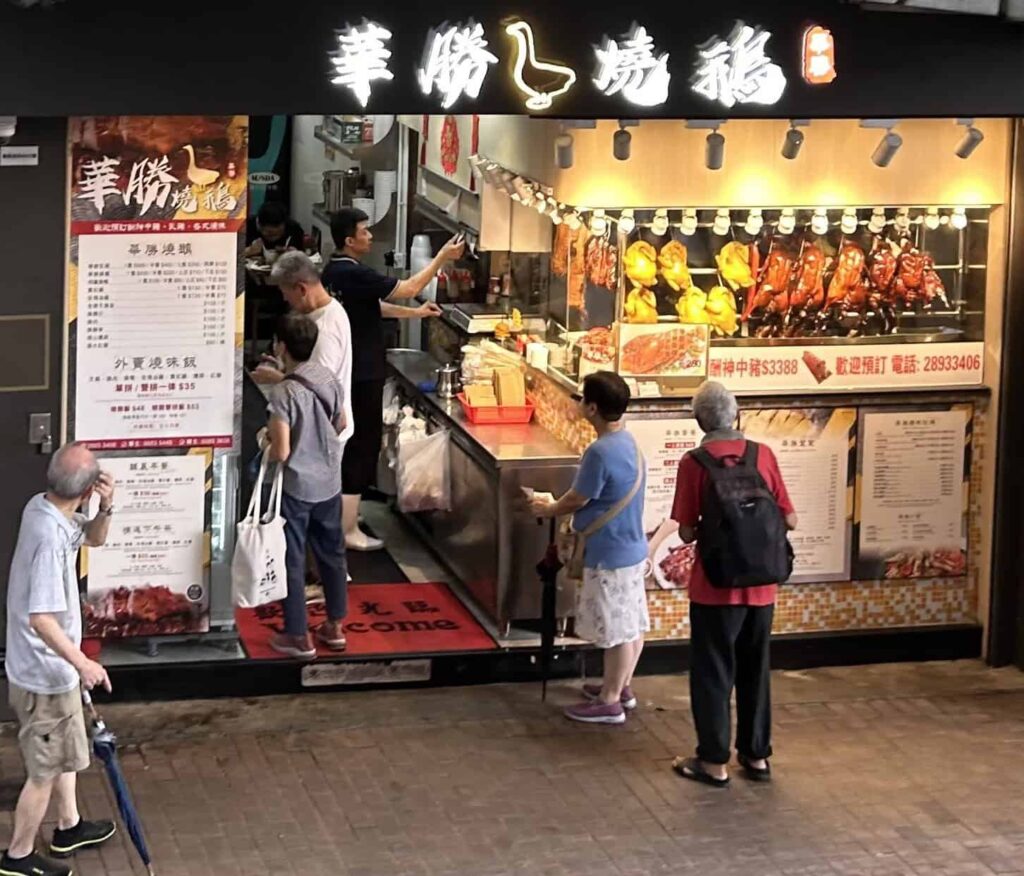
A few things shape how people eat in Hong Kong:
- Eating out every day is normal
- Meals are often shared
- Speed and efficiency matter
- Traditional Cantonese food sits alongside global cuisine
- Queuing and table sharing is a thing
Below, I’ll walk you through how each of these works in practice—so you know what to do when you sit down to eat.
If you’re feeling unsure what to order or where to go, I recommend starting with a food tour. This is the exact food tour I recommend for first-timers →
Why Eating Out Is Part of Hong Kong Culture

Hong Kong is one of those places where locals eat out all the time, not just for special occasions or treats. Personally, I don’t think it’s because eating out in Hong Kong is particularity cheap or cheaper than preparing food yourself (although it definitely can be), I think it’s more about convenience and socialising.
Apartments are small. Kitchens are small. People work long hours and are constantly out and about. It often makes more sense to eat where you are than to go home and cook.
But it’s also cultural.
Chinese family dining is built around sharing. Think round tables with a lazy Susan in the middle (that spinning glass platform) and multiple dishes placed down for everyone to help themselves. It’s social. It’s communal. It’s rarely rushed at family level, even if the restaurant pace feels quick. Weekends, in particular, are big for local families eating out. It’s part of how people connect.
Growing up, my family ate out at least three times a week — everything from cheap local restaurants to hotel dining and even McDonald’s — it just felt like part of everyday life here.
Hong Kong is a melting pot of (very good) international cuisine

Traditional Cantonese cooking sits beside British-influenced café culture. You can move from dim sum to Indian curry, Korean barbecue, French pastries, or English-style afternoon tea within a few city blocks.
I was exposed to all sorts of food early on — Indian, French, Korean — which is probably why I still like so much variety now.
The international food in Hong Kong is unusually good and one of the reasons that makes Hong Kong such a great destination to visit. High-end hotel dining is strong. Mid-range neighbourhood spots can be excellent. Price varies wildly — and I’ll break that down later — but quality overall is high.
If you’re not sure where to start, here’s what to eat in Hong Kong.
Unique Things About Hong Kong Food Culture

When you start eating your way around the city, you’ll notice lots of things unique to Hong Kong:
👉 Live seafood tanks outside restaurants You point, they cook. Very fresh. Not for the squeamish. Great for photos.
👉 Cha chaan teng cafés. These are local Hong Kong cafés with Western-Chinese fusion dishes. They are fast, noisy and serve some unusual staple menu items like milk tea (nope, I’m not a fan), french toast, macaroni soup with ham, and baked pork chop rice. I actually avoided cha chaan tengs for years because I found them intimidating, but after finally going into one on a food tour, I realised they’re much easier to navigate than they look.
🍜 If you want help navigating a cha chaan teng menu for the first time, a food tour makes things much easier. See my review of the Sham Shui Po food tour I did.
👉 A strong Dim sum culture. It’s everywhere, at almost any time of day, but locals especially love it around 11am — yum cha time. If you’re a dumpling fan, you’ll be very happy. And even if you’re not, it’s a Hong Kong experience you shouldn’t miss.
If you don’t want to figure out what to order, this dim sum tasting menu is an easy option for first-timers →
👉 There’s not a huge street food scene compared to places like Bangkok or Hanoi. Yes, you’ll find snacks that you’ll eat standing up (fish balls and egg waffles), and there’s the Temple Street Night Market where you can sample Hong Kong’s local snacks, but big food type markets don’t exist here.

👉 Very good bakeries. I’m not entirely sure why there are so many — maybe a colonial thing, maybe just Hong Kong doing its own thing — but they’re everywhere. Think single-portion cakes, pineapple buns, egg tarts, sausage buns, and soft bread that’s slightly sweet and a little yellow. I’ll usually grab a sausage bun and a pineapple bun first thing in the morning on my way to the MTR for day of sightseeing. Fresh, cheap and very, very good.
👉 Lavish high teas. A leftover from the colonial days for sure. Bite-size savouries, dainty cakes that look too pretty to eat, usually served in high-end hotels and restaurants across the city. I still book a high tea every trip because I love the experience and have a massive sweet tooth.
👉 Lots of international-style buffets. These have always been a feature of Hong Kong’s food scene, especially in high end hotels. Another early food memory for me is these buffets: huge seafood spreads, chocolate fountains, and the novelty of being able to go back as many times as I wanted. They’re not quite as over-the-top as they used to be, and the quality (and quantity) isn’t quite the same — maybe a post-Covid thing — but I still try one or two buffets when I’m back.
🥗 If you want a more relaxed, all-in-one introduction to Hong Kong food, I’ve written a full review of The Grand Buffet — my favourite buffet in the city and one I highly recommend for first-timers.
Why Dining Feels Fast in Hong Kong

Restaurants in Hong Kong move quickly. Tables turn fast, staff are efficient, and meals are often shorter than what many Western travellers are used to.
In local style restaurants, food usually arrives rapidly and not always in course order. You might receive your mains before your drinks, or several dishes all at once. It can feel chaotic if you’re not expecting it, but it’s simply how restaurants keep up with the city’s pace.
Service can also feel brisk. Staff aren’t being rude, they’re focused on speed and efficiency. If you need something, it’s completely normal to wave or call a server over rather than waiting for them to check back.
Bills may also arrive quickly, sometimes without being requested. This usually signals the restaurant is preparing for the next seating, not that they want to rush you out the door. Locals are used to shorter dining experiences, especially during busy periods.
Queuing for Food Is Part of Hong Kong Culture

If you see a long line outside a restaurant in Hong Kong, that’s usually a very good sign.
Locals are more than happy to queue for great food, and popular restaurants often have waiting lines that start forming before they even open. Smaller eateries rarely take reservations, so queues are simply part of the culture.
I remember eating at McDonald’s as a kid and having people stand behind our table while we were still eating, waiting for us to finish so they could grab the seats. These days, I tend to avoid long queues — if it’s too busy, I’ll usually just go somewhere else.
If you’re short on time, try eating slightly earlier or later than peak lunch (12–2pm) and dinner (6:30–8:30pm). And if the line is too long, don’t stand there. Your travel time is too precious. Just go somewhere else.
Table Sharing in Hong Kong Restaurants (What to Expect)

In busy local restaurants, particularly older or smaller ones, you may be seated at a shared table with other diners. This is simply how restaurants maximise space in a city where real estate is extremely limited.
It might feel unusual at first, but it’s entirely normal in Hong Kong and rarely awkward. Most diners simply focus on their own meals, and table sharing is generally efficient and friendly.
I’ve sat at shared tables countless times — you don’t talk, everyone just stays in their own bubble — and after the first time, it feels completely normal.
But don’t worry too much about this; it’s not all that common.
If the idea of shared tables or not knowing what to expect feels a bit intimidating, this is exactly where a food tour can really help — you’re guided through the experience, know what to order, and don’t have to figure it all out on your own.

Hong Kong Foodie Tour (Sham Shui Po)
⭐ Best for authentic local food experiences
⭐ Licensed English-speaking guide
⭐ Great for first-time visitors
⭐ Includes multiple tastings over 3 hours
Why Some of the Best Food in Hong Kong Is Hard to Find

Sometimes it can be surprisingly hard to find a particular restaurant. They’re often in random spots: on the second floor of an office block, tucked down an alleyway, sometimes with barely any signage at all.
I’ve run into this more times than I can count, and it’s especially frustrating when you’re hungry.
This is another reason I like doing a food tour at the start of a trip — you discover places you’d never find on your own.
If you’ve got your heart set on a specific place, check Google Maps properly beforehand so you know what building you’re looking for. And don’t give up if you can’t find it straight away.
More than once I’ve nearly given up trying to find a place — an Indian resturant called Chutney near Tai Kwun took me ages to track down on the third floor — but it’s often worth the effort.
In my experience, the places that take a bit of effort to track down often end up being the best meals: even if you do end up circling the block a few times.
Tea, Snacks, and Extra Charges (What’s Normal in Hong Kong)

In many Cantonese restaurants, tea is served automatically and charged per person. Small items like peanuts, condiments, or wet towels may also appear without being ordered and will usually be added to the bill.
These charges are typically small and part of traditional dining customs, but they can surprise visitors who aren’t expecting them.
Why Sparkling Water Can Be Expensive in Hong Kong

I’ve made this mistake myself more than once.
If staff offer sparkling water, it’s usually best to politely decline unless you specifically want it. Many restaurants automatically bring a large imported bottle — often something like Perrier or another premium brand — and it can easily cost more than your entire meal.
Tap water isn’t always automatically offered in Hong Kong restaurants, so if you prefer still water, it’s worth asking for it directly or sticking with tea, which is commonly served anyway.
For more tips about Hong Kong, read 32 Essential Hong Kong Travel Tips Every First-Time Visitor Should Know
How Paying Works in Hong Kong Restaurants

How you pay varies depending on the restaurant.
In a dim sum restaurant, you’ll usually tick items off a sheet as you order, then pay at the counter on your way out.
In fast-food style places, you order and pay first, then find a seat — places like Hungry Korean work this way.
In most other restaurants, you’ll need to signal the waiter for the bill by catching their eye and giving a small wave. They’ll bring a folder or a card machine to your table, and you pay there.
Tipping in Hong Kong (Service Charges Explained)

The 10% service charge in Hong Kong restaurants is automatically added to your bill — you’ll see it listed at the bottom.
So, do you tip in Hong Kong? Technically no — the 10% service charge covers it. But small extra tips are appreciated.
Years ago, leaving something extra was more expected. These days, locals don’t always tip on top of the service charge, but if you do, it’s appreciated.
I usually leave a little extra for good service, round up for taxi drivers, or tip anyone who’s gone out of their way to help.
It’s not mandatory. But it makes you a good human.
The Easiest Way to Experience Hong Kong Food Culture
If you’re visiting for the first time, trying to figure all of this out on your own can be overwhelming.
That’s why I always recommend starting with a food tour — it helps you understand what you’re eating, how to order, and where to go.
👉 Best Hong Kong Food Tours (Compared & Reviewed)
Or if you prefer a more relaxed experience:
🥗 Book this incredible rotating buffet with 360° views over Hong Kong, or
🍰 Experience a traditional Hong Kong high tea in the elegant surroundings of Madame Fu restaurant.
Read More Posts about Eating Out in Hong Kong 👇
- How Expensive Is Food in Hong Kong? What I Spend on My Trips
- What to Eat in Hong Kong: A First-Timer’s Guide
- Gluten-Free in Hong Kong: A Guide to Eating with Dietary Restrictions
- Is a Food Tour Worth It in Hong Kong? (My Honest Take)
- Best Food Tours in Hong Kong for First-Timers
- Hong Kong Foodie Tour Review: Is it Worth Booking?
- Are Hong Kong Buffets Worth It for First-Time Visitors?
- Grand Buffet Hong Kong Review: The Amazing Buffet Most Tourists Miss
- Best Afternoon Tea in Hong Kong (What’s Actually Worth It + My Honest Picks)
- Madame Fù Afternoon Tea Review (Tai Kwun): What It’s Actually Like
