How to Use the Hong Kong Airport Express (A First-Timer’s Guide)


Disclosure: This article contains affiliate links. See the Disclosure Policy.
The Hong Kong Airport Express is one of the quickest, easiest and most reliable ways to get from Hong Kong International Airport into the city.
If you’re arriving during the Airport Express operating hours (service hours are 5:50am to 1:15am), travelling with a normal amount of luggage, and don’t mind catching a short taxi ride at the end of your journey, it’s an excellent option. The train takes around 22 minutes to Kowloon Station and 24 minutes to Hong Kong Station in Central.
I’ve been using the Airport Express since it opened in the late 1990s and have taken it more times than I can count. While it’s genuinely easy to use, there are a few things that can catch first-time visitors out. Things like where to buy tickets, which station to get off at, when you need to scan your ticket, and what to do once you arrive.
One mistake I see visitors make all the time is trying to continue their journey on the regular MTR with luggage. Personally, I think you’re much better off taking a taxi from Kowloon or Hong Kong Station to your hotel.
In this guide, I’ll show you exactly how to use the Hong Kong Airport Express step-by-step, including how to buy tickets, where to board, which station to choose, and what to do when you arrive.
Quick Answer: How to Use the Hong Kong Airport Express
📍To use the Hong Kong Airport Express:
- Follow the Airport Express signs from Arrivals.
- Buy a ticket online before you arrive, from a machine, counter, use an Octopus Card or credit card.
- Board the train at the airport station. (You don’t scan your ticket until you get off).
- Get off at Tsing Yi, Kowloon, or Hong Kong Station.
- Scan your ticket or QR code at the exit gates.
- Take a taxi to your hotel.
👉 Easiest option: book your Airport Express ticket online before you land, then scan the QR code when you exit at Kowloon or Hong Kong Station.
1. What Is the Hong Kong Airport Express?

The Airport Express is a high-speed train run by Hong Kong’s MTR system (Metro) that connects the airport directly to the city. It’s one of the fastest, easiest airport-to-city links anywhere in the world. It takes 24 minutes from the Hong Kong airport to Central.
It only stops at three places:
- Tsing Yi (New Territories)
- Kowloon
- Hong Kong Station (Central on Hong Kong Island)
It’s not part of the regular Hong Kong MTR. This line was built just for airport travellers. This means wide seats, luggage racks, free Wi-Fi, and no crowds.
If you’re used to dragging a suitcase through subways in other cities, the Hong Kong Airport Express will feel like a breath of fresh air.
If you’re still comparing trains, taxis, buses and transfers, I break down all your airport-to-city transport options in a separate guide.
2. How Much Does the Airport Express Cost?
The Airport Express isn’t the cheapest way to get into Hong Kong (that would be the bus), but it’s still reasonably priced given how fast, comfortable, and reliable it is. For most visitors, these are the fares you’ll need to know:
Hong Kong Airport Express Fares
| Destination | Adult Fare* | Travel Time |
|---|---|---|
| Tsing Yi | HK$73 | 14 mins |
| Kowloon Station | HK$105 | 22 mins |
| Hong Kong Station (Central) | HK$120 | 24 mins |
*Using an Octopus Card, QR code, or contactless payment.
Children aged 3–11 pay half-price and children under 3 travel free.
You will get a slight discount if you purchase a return fare ticket at the same time.
📍 My Tip: I buy my Airport Express ticket online before I leave home. It’s often slightly cheaper than buying a ticket at the station and means one less thing to worry about after a long flight.
Airport Express fares occasionally change, so check the official Airport Express website for the latest pricing.
3. What are the Hong Kong Airport Express Operating Hours?
The Airport Express does not run 24 hours. Service hours are from 5:50am to 1:15am
📝 Important: If you’re arriving outside these hours (e.g. red-eye flights), you’ll need to arrange an alternative such as a private transfer or taxi.
Trains run every 5-10 minutes, so there’s no need to worry about long waiting times. There’s also no queues. In all my years of using the Airport Express, I have never struck a time when the carriages were overly full or I couldn’t get a seat.
You can check the most up-to-date timetable at the official MTR website.
4. How to Buy a Ticket for the Hong Kong Airport Express

You have a few easy options for buying your Hong Kong Express tickets. Some are better than others.
Ahead of Time (Highly Recommended)
I always buy my Hong Kong Airport Express ticket online ahead of my trip. I use the Klook App and just scan the QR code when you get off at your stop. This saves a lot of hassle grappling with machines at the Airport when you’re tried and grumpy after a long haul flight.
At the Airport
You can buy Airport Express tickets from the self-service machines located near the station entrance. They accept both Hong Kong dollars and most major credit cards.
That said, I don’t usually recommend this option. On my last trip, only one machine was working and there was a queue of tired travellers waiting to use it. After a long flight, it’s just one more thing to deal with.

There are also Airport Express ticket counters in the Arrivals area. These can be useful if you also want to purchase an Octopus Card at the same time. (Before you decide, it’s worth reading my guide to the Hong Kong Tourist Octopus Card so you know whether you’ll actually use it.)
However, the counters don’t operate 24 hours a day, and the last time I arrived they weren’t staffed.
Contactless Credit or Debit Card
You may also be able to pay using a contactless credit or debit card, although I haven’t personally used this option.
Before relying on it, check that your card is accepted and whether your bank charges any overseas transaction or currency conversion fees. Depending on your provider, these fees can increase the overall cost of your journey.
You may also want to read my guide to how to pay for transport in Hong Kong before you arrive.
5. Where to Find the Airport Express at Hong Kong Airport

Once you’ve cleared customs at Hong Kong International Airport, you’ll step into the main arrivals hall. From there:
- Stay inside the terminal
- Follow the signs for “Airport Express”
- The entrance is clearly marked in both English and Chinese
📍 You do not need to leave the airport building to access the train. Just follow the signs and you’ll be on the platform in minutes.
6. Boarding the Airport Express

There are no turnstiles at the airport platform so you don’t swipe in with your ticket or barcode or anything. You simply:
- Walk onto the platform
- Board any train.
- Sit anywhere.
- Luggage racks are available near the doors
🎟️ If you purchased a ticket, hold onto it. You’ll need it to exit at your destination station.
👉 If you plan to use the MTR, trams, buses or ferries during your trip, the Airport Express + Tourist Octopus Card bundle is the easiest way to sort both before you arrive.

Trains are modern, clean, and air-conditioned. You’ll find plenty of space even with luggage. There is also free Wi-Fi onboard, although I had trouble logging on to it the last time I used the Airport Express.
7. Airport Express Train Stops (and Where to Get Off)
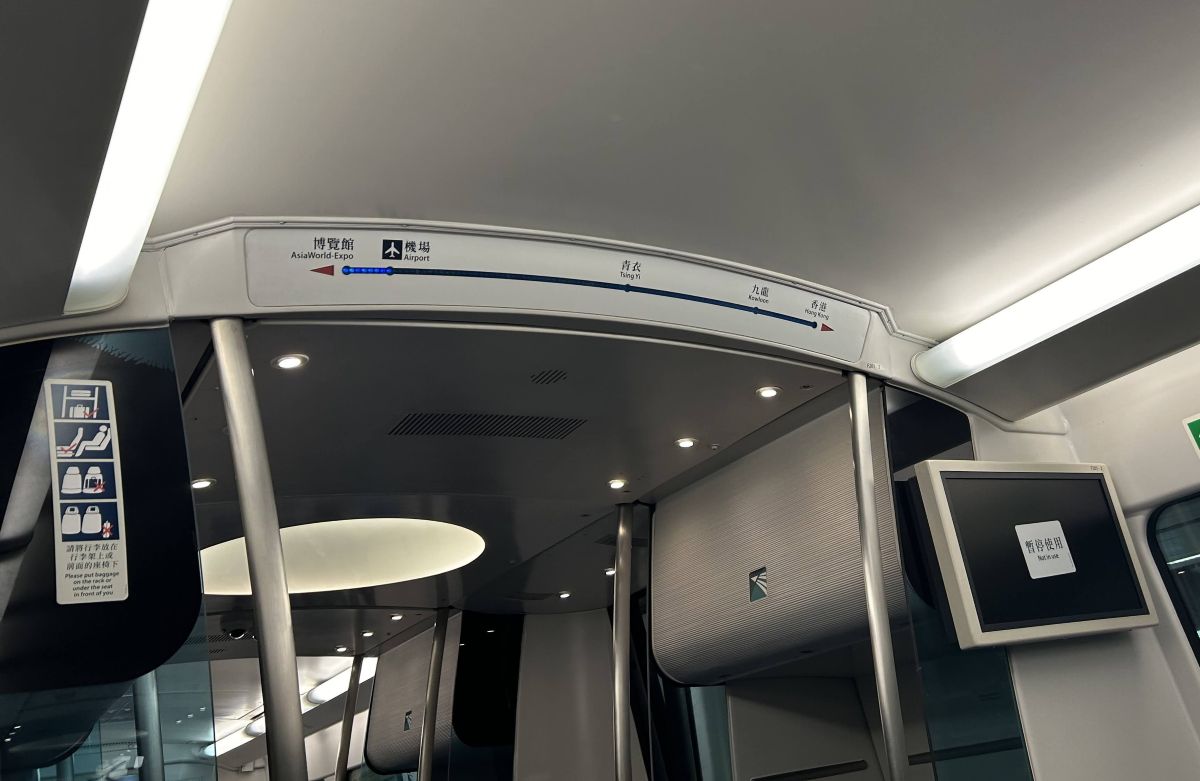
The Airport Express stops at three major stations:
- Tsing Yi Station – New Territories (14 mins from airport)
- Good for connections to Tung Chung Line
- Kowloon Station – Located in West Kowloon (22 mins from airport)
- Ideal if staying in Tsim Sha Tsui, Jordan, Yau Ma Tei or Mong Kok
- Hong Kong Station – Central District on Hong Kong Island (24 mins from airport)
- Best for Central, Sheung Wan, Soho, Wan Chai and Causeway Bay
Choose your stop based on your hotel’s location.
Which Airport Express Station Should I Get Off At?
| Staying In | Station |
|---|---|
| Tsim Sha Tsui | Kowloon |
| Jordan | Kowloon |
| Yau Ma Tei | Kowloon |
| Mong Kok | Kowloon |
| Central | Hong Kong |
| Sheung Wan | Hong Kong |
| Wan Chai | Hong Kong |
| Causeway Bay | Hong Kong |
If you’re still deciding between Kowloon, Central, Wan Chai or Causeway Bay, start with my guide to choosing the right area to stay in Hong Kong.
8. My Biggest Airport Express Mistake

🚫 Skip the MTR for the Last Leg
Don’t make the mistake of switching to the regular MTR after the Airport Express. It might look like a simple connection, but here’s the catch:
👉 The MTR is a completely separate system, so you’ll need to work out fares, routes and station exits.
👉 Once you arrive, you’ll usually still have to walk the rest of the way to your hotel. What looks like a short walk on Google Maps can easily involve stairs, pedestrian overpasses, busy intersections and crowded footpaths—all while dragging your luggage and trying to find your bearings.
I learned this lesson the hard way.
On one trip, I took the Airport Express to Kowloon Station, then switched to the MTR to get closer to my hotel in Tsim Sha Tsui. It sounded sensible in theory. In reality, it turned into a complete mission.
I ended up hauling my suitcase through multiple stations, dragging it up flights of stairs (thankfully a kind local helped me at one point), and then trying to navigate unfamiliar streets with luggage in tow. To make matters worse, I headed in the wrong direction and ended up at the opposite end of Tsim Sha Tsui from my hotel.
What should have been a quick journey added well over an hour to my arrival. By the time I finally checked in, I was exhausted, stressed, and later woke up with a migraine.
And this happened to me after decades of travelling to Hong Kong.
My advice is to take a taxi from Kowloon Station or Hong Kong Station straight to your hotel. It’s quick, relatively inexpensive, and saves you from turning your first hour in Hong Kong into an obstacle course. The small amount of money you’d save by using the MTR simply isn’t worth the hassle.
I explain more about Hong Kong’s public transport options, including taxis, in my full getting around guide.
9. What to Do When You Arrive at Your Stop

When the train arrives at your chosen station:
- Take your ticket and insert it at the exit turnstile (or wave your Klook barcode if you’ve pre-purchased your ticket)
- Follow signs to the Taxi Stand (there are elevators and escalators)
- Taxi stands are usually well-marked. If in doubt, ask a local (Hongkongers are friendly and used to visitors)
Taxis in Hong Kong are safe, clean, and affordable. It’s customary to round up your fare for a tip.
If you need cash, ATMs are widely available in each Airport Express station concourse.
📸 Tip: Take a screenshot of your hotel name and address in Chinese. Taxi drivers often speak limited English.
For more simple arrival advice, read my Hong Kong travel tips for first-time visitors.
10. In-Town Check-In: One of the Best Airport Express Perks

The Airport Express has a feature that I absolutely love: In-Town Check-In.
I used this service all the time before COVID, and I’m delighted that it’s finally returned for several major airlines.
If you’re anything like me, you’ve probably had flights that don’t leave until late in the evening. You check out of your hotel at 11 a.m., but your flight isn’t until 8 p.m. That leaves you with an awkward problem: what do you do with your luggage all day?
In-Town Check-In solves that problem beautifully.
Instead of dragging your suitcase around Hong Kong or heading back to your hotel to collect it later, you can check in for your flight and drop off your luggage at Hong Kong Station or Kowloon Station before heading out to enjoy your final day in the city.
Passengers travelling with participating airlines can check in as early as 24 hours before departure and up to 90 minutes before their flight. Once your bags are checked, they’ll be transported directly to the airport for you.
If you’re nervous about handing over your luggage so far from the airport, don’t be. I’ve used this service many times over the years and have never had a problem.
Airlines Currently Offering In-Town Check-In
At the time of writing, participating airlines include:
- Cathay Pacific
- China Airlines
- Hong Kong Airlines
- Mandarin Airlines
- Qantas
- Singapore Airlines
Always check the official Airport Express website before travelling, as participating airlines and operating hours can change.
No In-Town Check-In? Use the Luggage Storage Instead

If your airline doesn’t participate in In-Town Check-In, you can still store your luggage at Hong Kong Station.
I did this on my last trip and found it incredibly useful. The luggage storage facility is tucked away on the first floor and can be a little tricky to find. I ended up asking at the MTR service counter and they pointed me in the right direction.
One thing to note: when I used it, they only accepted cash or an Octopus card.
Once your bags are stored, you can spend the rest of the day exploring Central before your flight.
My Recommendation for First-Time Visitors
For most first-time visitors, the Hong Kong Airport Express is one of the easiest ways to start your trip. It’s fast, clean, reliable, and much less stressful than trying to work out buses or taxi fares while jetlagged.
My recommendation is to book your Airport Express ticket before you fly, take the train to Kowloon or Hong Kong Station, then grab a taxi to where your hotel is located. It’s the balance I use on most of my own Hong Kong trips.
If you’re still deciding whether the Airport Express is right for you, read my full guide to getting from Hong Kong Airport to the city, where I compare the train, taxis, buses and private transfers.
If you haven’t booked your accommodation yet, you may also want see my Tsim Sha Tsui hotel guide.
Hong Kong Airport Express FAQs
Is the Hong Kong Airport Express worth it?
For most visitors, yes. The Airport Express is fast, clean, reliable, and easy to use. It gets you from Hong Kong International Airport to Kowloon Station in around 22 minutes and Hong Kong Station in around 24 minutes. It’s the option I use for most of my own trips to Hong Kong.
Can I use an Octopus Card on the Airport Express?
Yes. You can pay for the Airport Express using an Octopus Card, contactless payment, a QR code ticket, or a traditional paper ticket. If you’re planning to use public transport during your trip, an Octopus Card is well worth having.
If you’re unsure whether you need one, I’ve written a full guide on whether the Tourist Octopus Card is worth it.
Which Airport Express station should I get off at?
Most visitors should use either Kowloon Station or Hong Kong Station.
Use Kowloon Station if you’re staying in Tsim Sha Tsui, Jordan, Yau Ma Tei, or Mong Kok.
Use Hong Kong Station if you’re staying in Central, Sheung Wan, Wan Chai, Soho, or Causeway Bay.
Does the Airport Express run overnight?
No. The Airport Express does not operate 24 hours a day. If you’re arriving after the last train has departed, you’ll need to use an alternative option such as a taxi or private airport transfer.
Can I buy Airport Express tickets at the airport?
Yes. Tickets can be purchased from ticket machines and Airport Express counters inside the airport. However, I usually buy mine online before travelling because it’s often slightly cheaper and saves time after a long flight.
Can I Take Large Suitcases on the Airport Express?
Yes. The Airport Express was designed specifically for airport travellers and has dedicated luggage racks near the doors. In all the years I’ve used it, I’ve never had any difficulty travelling with a full-sized suitcase.
✈️Travelling Soon?
These are the travel tools and booking sites I personally use and recommend most often when planning a trip to Hong Kong:
Travel Insurance: I use Visitor Coverage to compare travel insurance policies side-by-side before I book.
Flights: I search flights using Expedia to compare prices and routes.
Hotels: I book most of my Hong Kong hotels through Booking.com because the free cancellation policies are often really flexible.
eSIMs: I use Airalo for mobile data in Hong Kong and China. It’s easy to set up before you land.
Airport Express Tickets: I usually book Airport Express tickets through Klook because the QR-code entry makes arrival much smoother after a long flight.
