Lantau Island Day Trip: Ngong Ping 360, Big Buddha & Tai O


Disclosure: This article contains affiliate links. See the Disclosure Policy.
If you’re planning your first trip to Hong Kong, visiting the Big Buddha and Ngong Ping 360 cable car is one of the most popular day trips from the city.
I one hundred percent recommend you do it. It’ll give you a totally different version of Hong Kong.
The thing most people don’t realise is that visiting the Buddha isn’t just about seeing the ginormous statue. The whole experience—getting there, the cable car ride, the mountain views, and the nearby fishing village of Tai O—turns this into one of the best half-day or full-day outings you can do from the city.
I recently did this as a semi-DIY day trip, booking my cable car ticket and Tai O transport through Klook.
You can also join a fully guided tour if you’d rather skip the logistics entirely and have someone explain the cultural and religious side of the sites.
Either way, this is one of those Hong Kong experiences you’ll remember.
Quick Overview: Ngong Ping 360 & Big Buddha Day Trip

Location: Lantau Island
Travel time from Central: ~35–45 minutes
Time needed: 4 hours (Big Buddha only)
Full day if adding Tai O village
Highlights
- Ngong Ping 360 cable car
- Tian Tan Big Buddha
- Po Lin Monastery
- Ngong Ping Village
- Tai O fishing village
I booked my cable car ticket through Klook, which saved me from standing in the main ticket line. It’s the easiest way to secure your time slot, especially on weekends.
How to Get to Ngong Ping 360 from Central

First things first: you’ll need to head out to Lantau Island.
The easiest way is by MTR to Tung Chung Station, which is on the Tung Chung line heading toward the airport.
From Central it takes about 35 minutes, and you don’t need to take the Airport Express.
For more on the MTR, read my guide How to Use the Hong Kong MTR.
I deliberately went mid-morning to avoid the main commuter rush. The Tung Chung line also goes to Disneyland, so you’ll probably share the train with families heading there as well.
Hong Kong’s transport system is incredibly easy to use, even if it’s your first time here. Signage is excellent and everything is clearly marked.
Once you arrive at Tung Chung Station, you’ll come straight out into Citygate Outlets Mall.

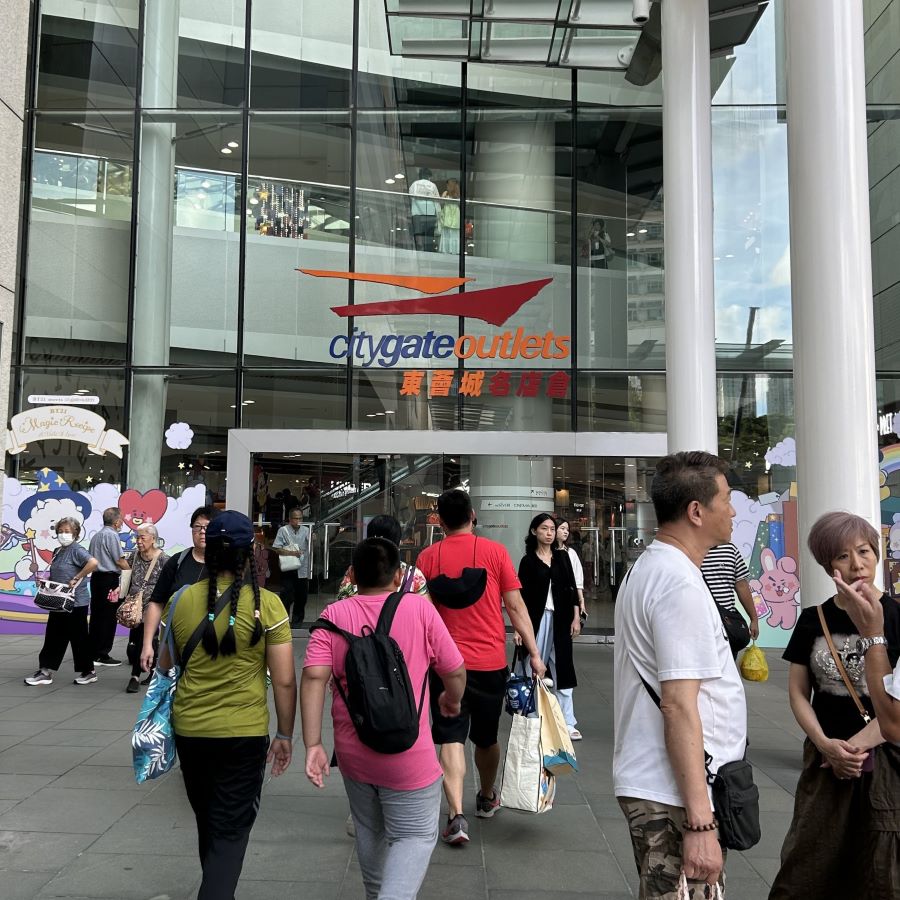
This is actually useful to know for later. After the trip, Citygate is a convenient place to grab a meal, cool off in air-conditioning, or browse a few shops before heading back into the city.
For Hong Kong standards it’s a bit out of the way, so I tend to combine the shopping with this day trip rather than making a separate journey.
Walking to the Ngong Ping 360 Cable Car

From the MTR station, simply follow the signs for Ngong Ping 360.
You really can’t miss them.
The cable car station is about a five-minute walk, and the entire area is clearly marked for visitors.
If you’re planning this trip, here’s one piece of advice: Book your tickets in advance.
Don’t assume you can just show up and buy one on the day, especially on weekends or public holidays. The queue to buy tickets on the day can be over an hour long, whereas the queue for people with pre-booked tickets can be as little as 20 minutes.
If you want more detailed instructions, read my separate guide How to Visit the Big Buddha in Hong Kong (Step-by-Step Guide)
Riding the Ngong Ping 360 Cable Car

The cable car ride is one of the highlights of the entire day.
It lasts about 25 minutes, which surprised me the first time I did it. It’s much longer than most gondola rides you find at tourist attractions.
You glide slowly up the mountainside, high above the jungle-covered hills of Lantau Island.
About halfway through the ride, the city completely disappears and you’re surrounded by mountains and forest.
There are two types of cabins.
Standard Cabin
- Regular gondola
- Fully enclosed
- Most people choose this option
Crystal Cabin
- Glass floor and panoramic glass walls
- Slightly more expensive
- A bit gimmicky, but fun if you like dramatic views
I went with the standard cabin and it was perfectly fine.
As the gondola crests the mountain ridge, something pretty spectacular happens.
The Tian Tan Buddha slowly appears in the distance, sitting high above the hills.
In my cabin, everyone suddenly went quiet for a moment. It’s much bigger than you expect.
Arriving at Ngong Ping Village

When the gondola reaches the top, you’ll step out into Ngong Ping Village.
Now let’s be honest. This is a purpose-built tourist village, not a traditional settlement.
But I actually don’t mind it.
There are souvenir shops, small restaurants, a convenience store, and plenty of spots to grab a drink or snack.
Some of the souvenir shops here are actually better than the ones in central Hong Kong, so it’s worth having a wander.
The village itself isn’t huge. I spent about 20–30 minutes strolling around before heading toward the Buddha.
And trust me, you can’t miss it.
Climbing the Steps to the Big Buddha

At the end of the village, a long staircase leads up to the Tian Tan Buddha, commonly known as the Big Buddha.
You’ll need to climb 268 steps to reach the top.
It’s a bit of a workout, especially on a humid day, but the climb is manageable if you take your time.
As you climb, the statue gradually towers above you.
The Buddha was completed in 1993 and is one of the largest seated bronze Buddhas in the world.
Around the base you’ll see several statues known as the Offering of the Six Devas, representing offerings to the Buddha.

But what I love most about this spot is the setting.
On the right day, the surrounding mountains are wrapped in mist and lush greenery. Looking out across the hills of Lantau Island, it’s surprisingly peaceful considering how popular the site is.
Visiting Po Lin Monastery

After coming back down the stairs, walk over to Po Lin Monastery, which sits right beside the Buddha.
This is an active Buddhist monastery and well worth exploring.
You’ll find:
- beautiful temple halls
- lotus ponds
- incense burners
- ornate pavilions
It’s a lovely place to slow down for a bit.

One small etiquette note: avoid taking photos directly of the deities inside the temples. That’s considered disrespectful.
There’s also a vegetarian restaurant and small shop run by the monastery, which helps support the temple.
Even if you only wander around for 30 minutes, it adds another layer to the visit.
Continuing to Tai O Fishing Village

If you have time, I highly recommend adding Tai O Fishing Village to the day.
This was originally a traditional fishing community, and many of the houses are built on stilts over the water.
It feels completely different from central Hong Kong.

When I booked my ticket through Klook, my package included:
- the gondola ride
- a bus transfer to Tai O
- a short boat tour
The bus departs from Ngong Ping Village.
It’s easy to find — you’ll see the queue.
And yes… there will probably be a queue.
I waited about an hour in the heat before boarding. That’s one downside of doing this as a semi-DIY trip rather than a fully guided tour.

The bus ride itself takes about 20 minutes, winding down narrow mountain roads until you reach the coast.
My Experience of Visiting Tai O

I really liked Tai O.
It has a completely different feel to Cheung Chau and Lamma Island, two other islands that are popular for day trips from Hong Kong.
Tai O is small, with narrow alleys and quaint old buildings.


You’ll find streets lined with:
- dried seafood shops
- local snack stalls
- small restaurants
- traditional homes on stilts
Tai O is also known locally for its shrimp paste, a strong-smelling ingredient often used in stir-fry dishes.
It’s very different from the modern parts of Hong Kong.
I spent some time wandering around before stopping for lunch at a small restaurant in one of the laneways.
If you enjoy seeing everyday life outside the city centre, Tai O is worth visiting.
The Tai O Boat Ride

Part of my ticket included a small boat tour through the village canals.
This ride takes you past the stilt houses, giving you a closer look at how the community is built over the water.
After that, the boat heads out into the open sea.
I read that we might spot pink dolphins, which sometimes appear in these waters.
Sadly we didn’t see any.
I’ll be honest though, this part of the trip felt a little chaotic. The boat sped around quite a bit and I don’t remember anyone insisting on life jackets. I was relieved to get back on dry land.
Still, it was interesting to see the surrounding coastline and the Hong Kong–Zhuhai–Macau Bridge in the distance.
The Downside of the DIY Route
After lunch and exploring Tai O, I headed back to catch the return bus.
This is where the biggest frustration of the day happened.
There were long lines and not enough buses.
I waited quite a while in the heat, and when the bus finally arrived I had to stand for most of the 20-minute ride back up the mountain.
If you’re short on time or prefer a smoother experience, this is where a guided tour might actually be worth considering.
Those tours handle transport more efficiently and you will avoid the waiting.
Returning to Tung Chung

Once the bus returns to Ngong Ping Village, you simply take the gondola back down the mountain.
Just keep an eye on the time.
The cable car closes usually around 6 PM (it can be open longer in summer).
After returning to Tung Chung, I spent some time wandering through the Citygate Outlets mall before heading back into Central.
How Much Time to Allow for your Day Ngong Ping Trip
If you’re doing the Big Buddha only, allow around 4 hours total from Central.
This includes:
- MTR travel both ways
- the gondola ride
- time to explore the Buddha and monastery
If you’re adding Tai O Village, plan for a full day, as there’s quite a bit of waiting involved with buses and transport.
Prefer to Visit Lantau on a Guided Tour?
You can absolutely visit Lantau Island independently, but there is a bit of organising involved.
You’ll need to sort out your Ngong Ping 360 tickets, get yourself around the different sights, and, if you’re adding Tai O, work out the local bus connections as well.
I’ve done this trip independently many times and I still enjoy doing it that way, mainly because I like being able to spend as long as I want in each place. But for a first visit, I can definitely see the appeal of having someone else take care of the logistics.
The guided tour I recommend includes the main Lantau highlights: the Ngong Ping 360 Cable Car, Big Buddha, Po Lin Monastery and Tai O Fishing Village. Transport is organised for you, there’s an English-speaking local guide, and you also get a boat ride through the stilt-house area of Tai O.
One of the biggest advantages is the skip-the-line cable car access. The queues at Ngong Ping can get very long, so this alone can save you a surprising amount of time.
Depending on the option you book, you can also choose hotel pick-up from selected hotels or meet the group at a convenient location in Tsim Sha Tsui.
For me, travelling independently still wins when I have plenty of time. But if you only have a few days in Hong Kong, don’t particularly enjoy figuring out transport, or simply want an easy day where everything is taken care of, this is a very good alternative.
If you’re still working out how much time to allow for your trip, my guide to how many days you need in Hong Kong can help you decide whether a Lantau day trip fits comfortably into your plans.
If you’re visiting for a long weekend, you can also use my 3-day Hong Kong itinerary to see how I’d fit the city’s main sights together without rushing.
My Honest Take
If you’re visiting Hong Kong for the first time, the Ngong Ping cable car and Big Buddha are absolutely worth doing.
For me, the gondola ride is worth doing even before you factor in the Big Buddha.
Adding Tai O gives you a glimpse of a completely different side of Hong Kong, but it does add complexity to the day.
If you like independent travel and don’t mind a bit of waiting, the semi-DIY route works fine.
If you’d rather keep things simple, a guided tour could be the smarter option. Either way, this trip shows you something many first-time visitors don’t expect.
Hong Kong isn’t just skyscrapers.
Within an hour, you’re in mountains, monasteries, and fishing villages. And that contrast is exactly what makes the city so interesting.
Frequently Asked Questions about Ngong Ping 360, Big Buddha & Tai O
Is the Ngong Ping 360 cable car worth it?
Yes. The 25-minute ride over Lantau Island offers some of the best views in Hong Kong and is part of the experience of visiting the Big Buddha.
How long does Ngong Ping 360 take?
The cable car ride takes about 25 minutes each way.
How many steps are there to the Big Buddha?
There are 268 steps leading up to the Tian Tan Buddha.
Can you visit Tai O from the Big Buddha?
Yes. Tai O fishing village is about 20 minutes by bus from Ngong Ping village.
Other easy first-timer activities
These are some of the most popular sightseeing activities for a first-time visit to Hong Kong:
- Victoria Peak for Hong Kong’s most famous skyline view
- Stanley for a relaxed seaside outing
- The Star Ferry for a quick harbour experience
- A Hong Kong public tram ride for inexpensive sightseeing
- A museum visit for a rainy or very hot day
✈️Travelling Soon?
These are the travel tools and booking sites I personally use and recommend most often when planning a trip to Hong Kong:
Travel Insurance: I use Visitor Coverage to compare travel insurance policies side-by-side before I book.
Flights: I search flights using Expedia to compare prices and routes.
Hotels: I book most of my Hong Kong hotels through Booking.com because the free cancellation policies are often really flexible.
eSIMs: I use Airalo for mobile data in Hong Kong and China. It’s easy to set up before you land.
Airport Express Tickets: I usually book Airport Express tickets through Klook because the QR-code entry makes arrival much smoother after a long flight.
